
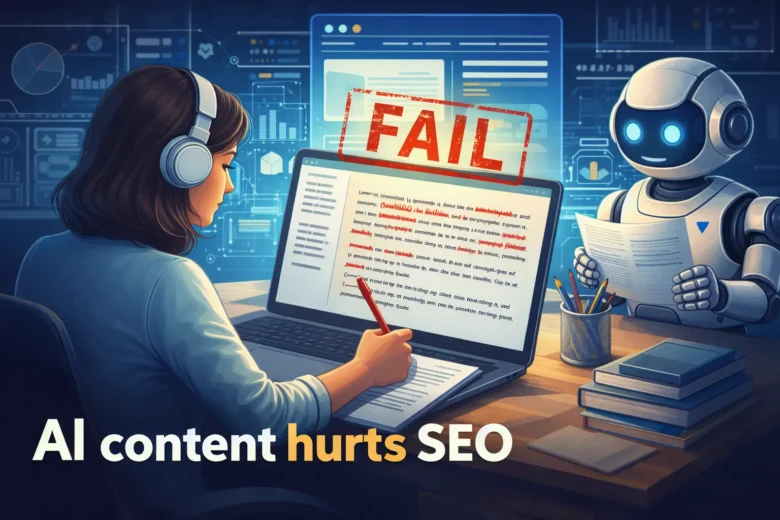
AI-generated content is now everywhere, but many websites publishing it are struggling to rank. While automation has made publishing easier, AI content hurts SEO when it’s used without strategy, human editing, or real value.
These AI content ranking issues explain why so many new blogs fail to gain visibility, even after following basic SEO practices
This raises an important question: Does AI content hurts SEO, or is something else going wrong?
The truth is that Google does not penalize AI-generated content by default. However, when AI is used without proper editing, experience, and structure, it often leads to low-quality pages that fail to meet Google’s expectations.
Why Google Doesn’t Penalize AI — But Filters Low-Value Content
Google has clearly stated that content quality matters more than the method used to create it. Whether content is written by humans or assisted by AI, it must provide genuine value to users.
Problems arise when websites publish low-quality AI-generated content that lacks originality, depth, and real-world insight. These pages add little to the existing web ecosystem, making them less useful for searchers.
low-quality AI-generated content
Link to: AI Slop: Quality vs Quantity
Common Reasons AI Content Fails to Rank on Google
Many AI blogs fail not because they use AI, but because they rely on it incorrectly.
1. Publishing AI output without human editing
Unedited AI content often sounds repetitive and generic, making it easier for Google to detect low effort.
2. Lack of experience or original perspective
AI summarizes existing information but cannot replace personal experience or expert insight.
3. Thin content written only for keywords
Pages written purely for keyword targeting usually fail to satisfy search intent.
4. Overdependence on automation
Many creators make the mistake of relying entirely on AI tools rather than using them as assistants.
Relying entirely on AI tools
Link to: Can You Really Rely on AI Tools?
AI Content vs Human Content: What Actually Performs Better?
The most successful websites today follow a hybrid approach. AI is used to assist with research, structure, and drafting, while humans refine the content with clarity, originality, and intent.
Google has publicly explained that content should be helpful, written for users, and demonstrate experience and expertise.
Google’s guidance on AI-generated content
Link to: https://developers.google.com/search/blog/2023/02/google-search-and-ai-content
How to Use AI Content Without Damaging SEO
Using AI responsibly can improve productivity without harming rankings.
Best practices:
- Use AI for research, not final publishing
- Rewrite content in a natural, human tone
- Add personal insights and examples
- Focus on one clear topic per page
- Strengthen internal linking between related posts
- Update older content instead of publishing only new posts
FAQs
Does AI content hurt SEO?
AI content itself does not hurt SEO. Poor-quality, unedited AI content can fail to rank due to lack of value.
Why don’t AI blogs rank on Google?
Most AI blogs lack originality, experience, and proper content structure.
Is AI-generated content considered spam by Google?
No. Google evaluates usefulness and quality, not whether AI was used.
Can AI content survive future Google updates?
Yes, if it is human-edited, useful, and aligned with Google’s quality guidelines.
Should AI be used for blogging in 2026?
AI should be used as a support tool, not a replacement for human creativity and judgment.