
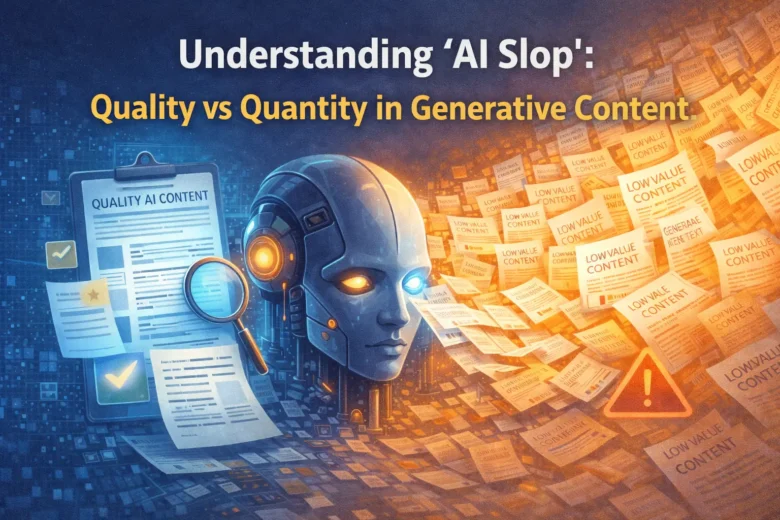
As AI-generated content becomes more common, many creators blindly depend on automation without understanding its limits. Before relying entirely on automation, it’s important to evaluate how reliable AI tools really are and where they fail to deliver real value. AI Slop has quietly become one of the most talked-about problems in the world of generative content. Within the first few scrolls of the internet today, you can already feel it—endless articles, social posts, and blogs that look polished on the surface but say very little underneath. As artificial intelligence tools flood the digital space, the line between valuable information and meaningless output is becoming dangerously thin.
At first glance, generative AI feels like a miracle. It produces content at lightning speed. However, when quantity begins to overpower intent, the result is often repetitive, shallow, and uninspiring material. This growing wave of low-value output is what many experts now call AI Slop.
What Exactly Is AI Slop and Why Does It Matter?
AI Slop refers to mass-produced, low-effort content generated by AI systems with minimal human oversight. While it may be grammatically correct, it often lacks originality, depth, emotional intelligence, and factual reliability.
Moreover, the problem isn’t AI itself—it’s how it’s used. When speed becomes more important than substance, content quality inevitably suffers. As a result, readers lose trust, search engines become stricter, and meaningful voices get drowned out.
The Rise of Generative AI Content and Its Hidden Cost
How Generative AI Content Took Over the Internet
The rise of generative AI content has made publishing easier than ever. Anyone can generate hundreds of articles, captions, or scripts within minutes. Consequently, content volume has exploded across blogs, websites, and social platforms.
However, this convenience comes with a cost. When creators rely entirely on automation, context and originality disappear. Instead of insight-driven writing, the web fills with recycled ideas and predictable phrasing.
Why Quantity Is Winning Over Quality
Because AI rewards speed, many platforms prioritize output over refinement. This leads to AI content overload, where users are exposed to massive amounts of information with very little value. Over time, audiences become fatigued and disengaged.
AI Content Quality vs Low Quality AI Content
What Defines High-Quality AI Content?
High-quality AI-assisted content still involves human judgment. It is:
- Context-aware
- Fact-checked
- Emotionally engaging
- Purpose-driven
This problem isn’t limited to writing alone. The same quantity-over-quality mindset can be seen across tech trends, where tools promise speed but sacrifice depth—similar to what we see in modern AI tools shaping content creation today. AI should assist creativity, not replace it.
The Problem With Low Quality AI Content
On the other hand, low quality AI content often includes vague explanations, keyword stuffing, and repetitive ideas. It may rank briefly, but it rarely builds trust or long-term engagement.
Furthermore, such content harms brand credibility and reduces reader satisfaction.
AI Generated Text Issues That Are Hard to Ignore
Repetition and Predictability
One of the most common AI generated text issues is repetition. AI models tend to recycle common phrases, leading to content that feels familiar but uninspired.
Lack of Real Experience
AI cannot replace lived experience. Therefore, articles generated without human input often lack authenticity, personal insight, or emotional depth.
Factual and Contextual Errors
Without proper review, AI-generated content can spread misinformation. This creates serious risks, especially in finance, health, and education-related topics. Google’s evolving algorithms are designed to reward experience and originality, which is why creators focusing on human-written, experience-driven blogs are more likely to survive future updates.
AI Writing Problems Are Forcing Creators to Rethink Strategy
As AI writing problems become more visible, creators are re-evaluating how they use AI tools. Instead of letting AI lead, many are now using it as a supporting assistant.
This shift emphasizes:
- Editing and rewriting
- Adding unique perspectives
- Fact verification
- Human storytelling
As a result, content becomes more trustworthy and valuable.
Ethical AI Content: Where Responsibility Meets Technology
Why Ethical AI Content Matters
Producing ethical AI content means respecting readers, sources, and truth. It involves transparency about AI usage and accountability for published information.
Additionally, ethical content creation prevents the misuse of AI for clickbait, misinformation, and manipulation.
Balancing Automation With Integrity
AI should help creators think better, not faster at any cost. When used responsibly, AI enhances productivity without compromising quality.
AI Content Overload and the Decline of Reader Trust
The internet is currently experiencing severe AI content overload. Readers are overwhelmed with similar articles that offer little value. Consequently, attention spans are shrinking, and trust in online content is declining.
Search engines are responding by prioritizing originality, experience, and usefulness. Therefore, AI slop is not just a creative issue—it’s an SEO risk.
The Future of AI Content: Smarter, Not Louder
Will AI Slop Eventually Fade Away?
The future of AI content depends on how creators adapt. As algorithms become better at detecting low-value material, AI slop will lose visibility.
Where AI Is Headed Next
Future AI systems will likely focus on:
- Contextual understanding
- Personalization
- Collaboration with human creativity
This evolution will reward quality-driven creators while filtering out noise.
How Content Creators Can Avoid Producing AI Slop
To stay relevant, creators must:
- Use AI as a draft assistant, not a final author
- Inject personal experience and insights
- Edit rigorously
- Focus on reader intent
By doing so, AI becomes a powerful ally rather than a liability.
FAQs: Understanding AI Slop and Content Quality
What is AI Slop?
AI Slop refers to low-quality, mass-generated content produced by AI with little or no human refinement.
Is generative AI content always bad?
No. Generative AI content can be high-quality when guided, edited, and enhanced by human creativity.
Why is low quality AI content harmful?
It reduces trust, spreads misinformation, and overwhelms users with repetitive information.
How can creators maintain AI content quality?
By combining AI assistance with human editing, originality, and ethical responsibility.
What is the future of AI content creation?
The future of AI content lies in collaboration—where AI supports thoughtful, high-quality storytelling rather than replacing it.
Google’s guidance on AI-generated content
Google has repeatedly emphasized that content quality matters more than how it’s produced, as long as it demonstrates expertise and usefulness.
Final Thoughts
AI Slop is not a failure of technology—it’s a failure of intent. As generative AI continues to evolve, the real challenge lies in choosing quality over convenience. Creators who prioritize depth, ethics, and human insight will stand out in an increasingly automated digital world.
On the other hand, those chasing volume alone risk becoming invisible in the noise. The choice, ultimately, belongs to us.
AI-Driven Learning: How Students Are Using AI for Study Success
1 Comment